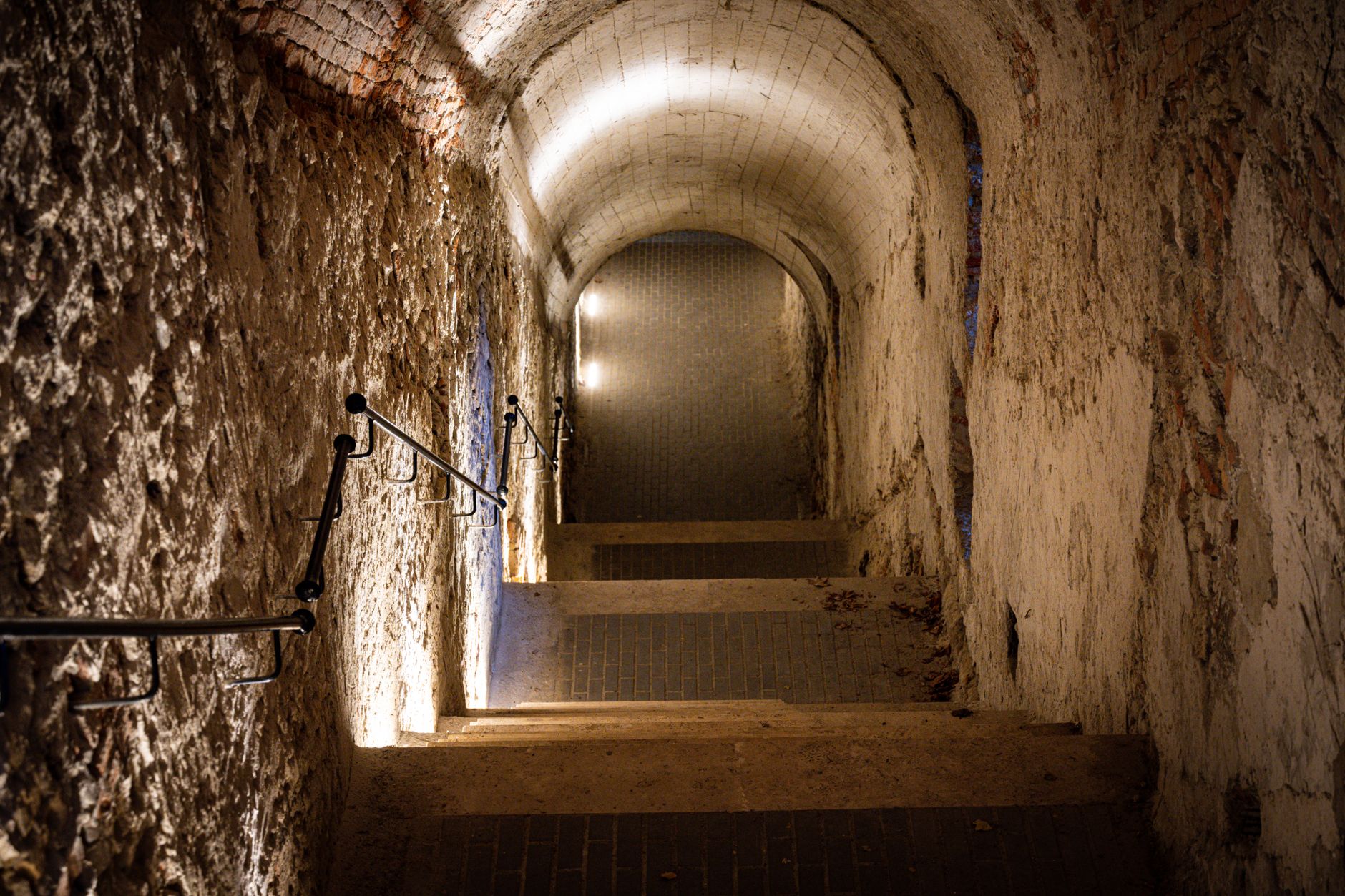
In June, Rome starts to bake. The asphalt radiates heat, the cool evening breeze is nowhere to be found, and waiting in line under the sun to enter the most famous monuments becomes an exercise in survival. Locals know the secret: during the hottest hours of the day, the only way to survive is to go underground. Beneath the modern street level lies a network of cool spaces where the temperature stays constant at around sixteen degrees Celsius without any need for air conditioning. Forget the usual catacombs: we are talking about houses and temples frozen in time for centuries, perfect for hiding from the summer heat.
Roman houses under the Caelian Hill
If you walk up from the Colosseo toward the Celio hill, along the cobbled street of the Clivo di Scauro, you leave the noise of tour buses behind. Beneath the Basilica dei Santi Giovanni e Paolo lies one of the best-preserved ancient residential complexes in the city. The Case Romane del Celio are a labyrinth of over twenty underground rooms spread out beneath the church.
Forget the usual bare ruins: here you walk through rooms decorated with frescoes showing marine scenes, ancient shops that once faced the street, and inner courtyards. During the summer, these spaces host evening events and special guided tours. You can find details and updated schedules by checking the programmazione estiva nei sotterranei.
To get there, you can take the metro, get off at the nearest stop, and walk. For updated information on admission fees, please check the sito ufficiale del turismo di Roma. It is an unusual place, rarely visited compared to the mass tourist routes, where the dampness and silence make you forget the traffic flowing just a few meters above your head.
The three levels of San Clemente
Not far away, along the road leading from the Colosseo to San Giovanni in Laterano, stands the Basilica di San Clemente. This place is a sort of layer cake of Roman history. Enter the medieval church at street level, buy your ticket to access the underground areas, and begin your descent.
The first lower level takes you inside a fourth-century basilica, with early Christian frescoes still visible on the brick walls. If you go down further, via a narrow staircase, you reach the first-century Roman level. Here you walk through a narrow alley, flanked by a large apartment building (an insula) and a mansion that housed a temple dedicated to the god Mithras.
The most striking thing about this lower level is the sound of water. You can hear a constant, strong flow: it is an ancient stream running through the Roman sewers and ending up in the Colosseum. The cool air down here is almost sharp, so much so that after half an hour you will want to put on a light shirt. The basilica is located on Via Labicana, within easy walking distance of the Colosseo metro stop.
Nero's palace under the park
Another option to escape the June sun is the Domus Aurea, the villa that Nero had built after the fire of 64 AD. Today, this massive structure lies beneath the park of the Colle Oppio. When later emperors decided to erase Nero's memory, they used the rooms of his palace as foundations for new baths, filling them with earth. This allowed the painted walls and ceilings to survive to this day.
The visit is done wearing a hard hat, accompanied by a guide, and access is limited for conservation reasons. Inside, the temperature is so low that you will need a light jacket even in the middle of summer. To book tickets and check updated rates, we recommend visiting the sito ufficiale del turismo di Roma.
The entrance is on Via della Domus Aurea, just a short walk from the Colosseo metro stop. Walking through these rooms, which are up to twelve meters high and lit only by artificial spotlights, gives you a clear sense of Nero's megalomania while offering two hours of absolute relief from the Roman heat.
Practical tips for underground visits
Before heading underground, there are a couple of things to keep in mind so you do not ruin your day.
- Bring a light sweater or a shawl. The temperature difference between the thirty-five degrees outside and the sixteen degrees underground can be significant.
- Wear comfortable shoes with rubber soles. Underground floors are often damp and slippery.
- Always check entry times on the official websites. Some of these places, like the Domus Aurea, require booking well in advance and are only open on certain days of the week.
If you want to plan your summer itinerary as best as possible and get updated information on museum openings, you can check the sito ufficiale del turismo di Roma.